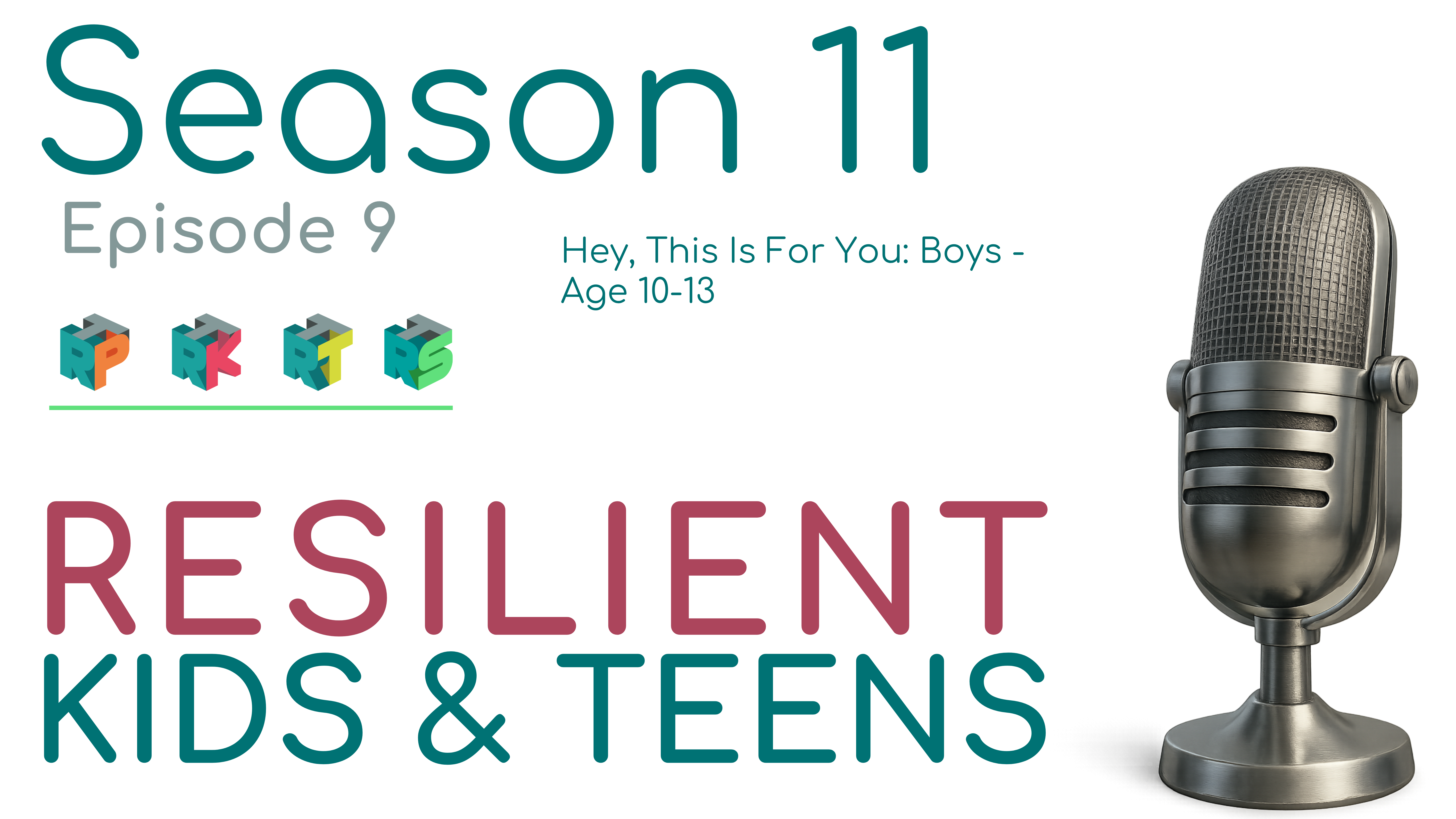
THE RESILIENT HUB PODCAST · SEASON 11, EPISODE 9
SHOW NOTES
"What is happening to you is normal. All of it."
This episode is different from everything else in Season 11.
It is not for parents. It is for boys — aged ten to thirteen — spoken directly to them, in language that treats them like the real and capable people they are.
It covers puberty from the inside: what is happening, why it is happening, and — crucially — the things that nobody usually warns boys about. Erections that arrive uninvited. Wet dreams. Masturbation. The emotional turbulence that comes alongside the physical changes. And a few things worth knowing about bodies, boundaries, and the fact that what they see online is not an accurate guide to any of it.
It is warm. It is honest. It is never preachy or clinical. It is the episode many of the boys listening will wish someone had given them earlier.
For parents: listen first, then share. Or share and listen together. Or simply leave it on a phone and say — I thought you might find this useful. Any of those work. All of them are a good idea.
This episode is made for young people aged 10 and over.
It contains age-appropriate discussion of puberty, the body, erections, wet dreams, and masturbation — all handled warmly and without shame. There is no explicit sexual content.
Parents — this episode is safe to share. It is designed to complement the conversations you are having at home, not replace them.
00:00 Age guidance and welcome
01:00 First things first — you are not weird
03:00 What's actually happening — and why
07:00 The stuff nobody talks about — masturbation and emotions
10:00 A few things worth knowing
12:00 The close
13:00 Outro
This section is written so it can be shared directly with a young person.
What puberty is: Your body upgrading itself from a child's body to an adult's body. It is driven by a hormone called testosterone and takes several years.
When does it start? Anywhere between 9 and 14. The range is wide and all of it is normal.
What about feelings? Emotions get bigger during puberty. This is neurological — the brain is rebuilding itself. It is not a character flaw. It gets easier.
Research by the PSHE Association on puberty education is clear: boys who receive accurate, age-appropriate information about puberty before the changes begin experience significantly less anxiety than those who encounter the changes without preparation. The wide variation in timing — some boys starting as young as nine, others not until fourteen — is a particular source of anxiety that is significantly reduced by simply being told that the range is normal.
?? PSHE Association — PSHE Association | Charity and membership body for PSHE education
Research consistently shows that boys who experience their first nocturnal emission without any prior preparation describe the experience as frightening and isolating. A brief, matter-of-fact conversation — or in this case, episode — beforehand entirely changes the experience. This is one of the clearest examples in adolescent development of how a small amount of information prevents a significant amount of unnecessary distress.
Debby Herbenick at the Kinsey Institute, Indiana University, has produced extensive research on sexual development and shame. Her work is consistent: shame attached to masturbation during adolescence does not prevent the behaviour. It accompanies it. Boys who are told — clearly, matter-of-factly, without drama — that self-stimulation is normal, private, and not harmful carry significantly less shame into their adult relationships.
?? Herbenick, D. — Sex Made Easy (Rodale, 2012)
Dr. Sarah-Jayne Blakemore's research at University College London on the adolescent brain is the foundation of the emotional section of this episode. The prefrontal cortex — responsible for impulse control and emotional regulation — is the last part of the brain to develop, and is not fully complete until the mid-twenties. The emotional turbulence of puberty is neurological, not behavioural. Boys who understand this about themselves are better equipped to manage it.
?? Blakemore, S.J. — Inventing Ourselves (Doubleday, 2018)
This episode signposts, but does not cover in detail, the issue of pornography and what it gets wrong. A full episode on this topic is coming in a follow-up to Season 11. For now — the Internet Watch Foundation and Brook both document that the majority of boys this age have encountered pornography online, usually without seeking it out. This episode names it briefly and honestly, and signposts that more is coming.
?? Internet Watch Foundation — Eliminating Child Sexual Abuse Online | Internet Watch Foundation IWF
?? Brook — http://brook.org.uk
S11E02 — Growing Up Boy — the parent version of this episode. Everything covered here, with the research in full and two family stories.
If your son has just listened to this episode — here are a few things that might help.
Don't make it a big moment. A casual "did you listen to that episode?" on a car journey is better than a sit-down conversation. Keep it low-key.
Be available for questions without pushing for them. "If anything came up that you wanted to ask about — I'm around." Then leave it. They will ask when they are ready.
Follow up on the things this episode signposts. Consent, relationships, and sex are all coming in later episodes of this season. You can share those when the time feels right.
Remember — you don't have to have all the answers. "I'm not sure — let me find out" is a completely valid response to any question. What matters is that you stay in the conversation.
YouTube link: https://youtu.be/ZXFPB5sKz5g
Spotify link: https://open.spotify.com/episode/2Jq3ZQdWGwVYvcd5Jd2p3Q?si=aigdWjGdQ7eK4msLEEFsXQ
• An Educator's Guide to Raising Resilient Learners (Waitlist): https://theresilienthub.co.uk/educators-guide-waitlist
• The Resilient School training and consultancy: https://theresilientschool.co.uk/trs-services
• A Parents' Guide to Raising a Resilient Kid: https://amzn.eu/d/0196zmiI
• Newsletter sign-up: https://theresilienthub.co.uk/newsletter-signup
• Main website: https://theresilienthub.co.uk/
• Facebook: https://www.facebook.com/resilientkiduk
• Instagram: https://www.instagram.com/theresilientkid
• LinkedIn: https://www.linkedin.com/in/resilientkid
• Email: ashley@theresilientkid.co.uk
The Resilient Kid Podcast is produced by Chantelle Venter at maddatu.com on behalf of The Resilient People, trading as The Resilient Kid, The Resilient Teen and The Resilient School.
Topics: anxiety, resilience, emotional regulation, parenting, boundaries, education, careers, creativity