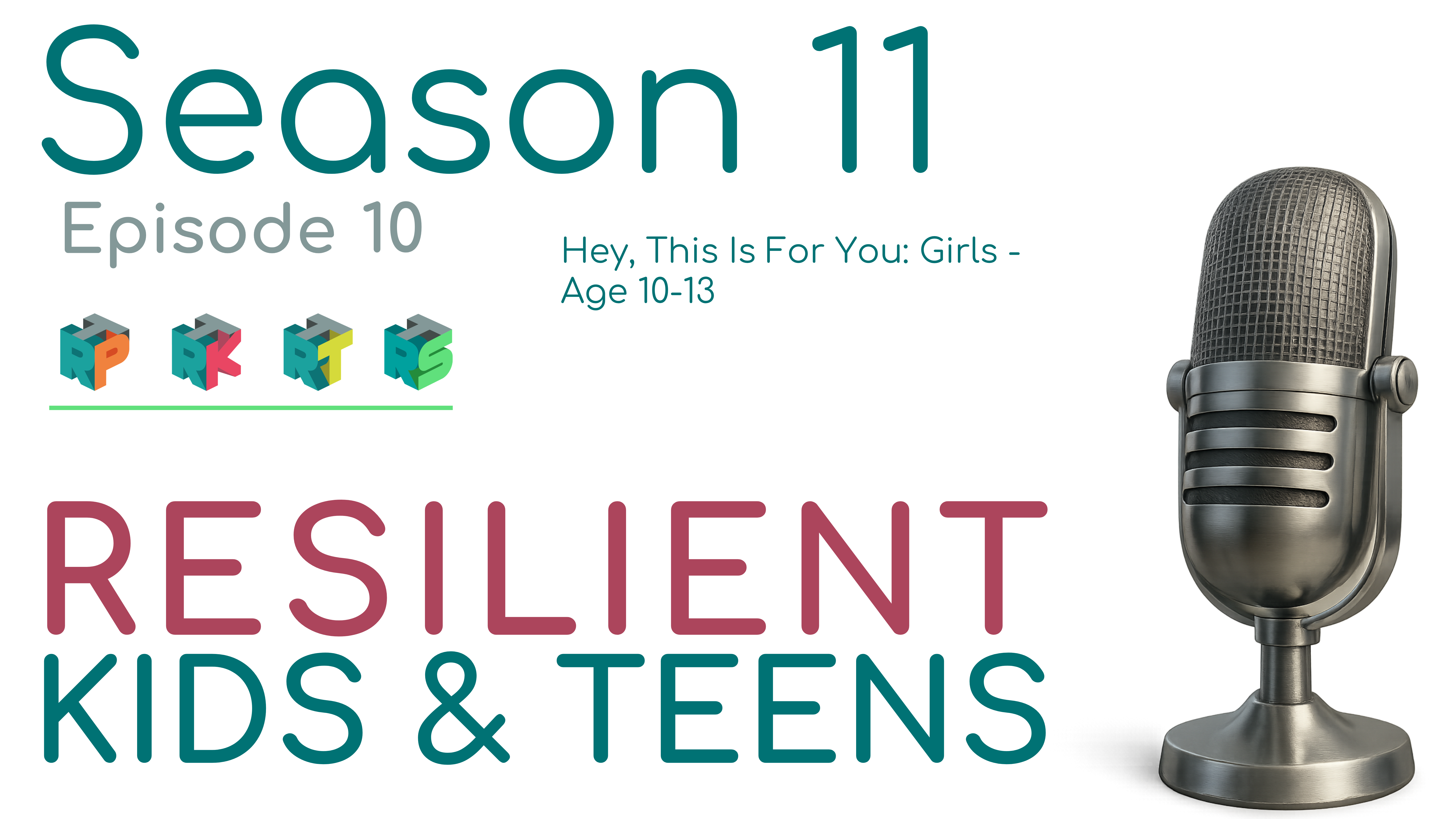
THE RESILIENT HUB PODCAST · SEASON 11, EPISODE 10
SHOW NOTES
This episode is spoken directly to girls aged ten to thirteen — in language that treats them like the capable, curious, real people they are.
It covers female puberty from the inside: breast development, body hair, discharge, periods in full detail, the correct names for their anatomy including the vulva and clitoris, masturbation and self-exploration, the emotional changes that come alongside the physical ones, body image and what they see online, and a few things about bodies and boundaries that every girl deserves to know.
It is warm. It is honest. It names things that are often left out — and does so without apology and without drama.
Listen first, then share. Or share and listen together. Or leave it quietly on a device. However it gets to her — it is worth getting there.
This episode is made for young people aged 10 and over.
It contains age-appropriate discussion of puberty, the body, periods, vaginal discharge, the vulva and clitoris, and masturbation — all handled warmly and without shame. There is no explicit sexual content.
Parents — this episode is safe to share. It is designed to sit alongside the conversations you are having at home, not replace them.
00:00 Age guidance and welcome
01:00 First things first — your body is not a problem
03:00 What's actually happening — and why
07:00 Let's talk about periods — properly
12:00 The stuff nobody always talks about
15:00 A few things worth knowing
17:00 The close
18:00 Outro
This section is written so it can be shared directly with a young person.
Your body changing from a child's body to an adult's body, driven by hormones. It takes several years and happens gradually.
Anywhere between 8 and 13. The wide range is entirely normal.
Emotions intensify during puberty. This is neurological — the brain is rebuilding itself. It is biology, not weakness.
NSPCC research and Dr. Jennifer Gunter's work both emphasise the importance of girls knowing the correct names for their own anatomy — vulva, vagina, labia, clitoris, uterus. Correct language reduces shame, increases safety, and gives girls the vocabulary to seek help if something is wrong.
?? NSPCC — NSPCC | The UK children's charity
?? Gunter, J. — The Vagina Bible (Piatkus, 2019)
As discussed in Episode 3, the full anatomy of the clitoris was not accurately mapped in medical literature until 1998. Girls who are not told it exists — and that it exists for their pleasure — receive an implicit message that their pleasure does not matter. This episode names it clearly, briefly, and matter-of-factly.
Vaginal discharge typically begins six to twelve months before a girl's first period. Research consistently shows that girls who encounter discharge without any prior information find it alarming. Like wet dreams in boys, this is an area where a small amount of prior information prevents a significant amount of unnecessary distress.
Dr. Lara Briden's evidence-based work on menstrual health, and Dr. Jen Gunter's period guidance, both emphasise that girls deserve accurate, detailed information about their menstrual cycle before it begins. Preparation significantly reduces anxiety around first periods. Knowledge of the full range of period products available — pads, tampons, period pants, menstrual cups — gives girls agency over their own experience from the start.
?? Briden, L. — Period Repair Manual
?? NHS — Periods — Periods
?? Brook — Periods Archives - Brook
One in ten girls in the UK has been unable to afford menstrual products. Every school in England is required to provide free period products under the Department for Education's Period Products scheme. If a young person is struggling to access products — at school or at home — support is available.
?? _Bloody Good Period — _bloodygoodperiod.com
?? Free Periods — Free Periods
?? DfE Period Products scheme — Welcome to GOV.UK
Debby Herbenick's research at the Kinsey Institute documents a significant gap between the information boys and girls receive about self-exploration. Girls are much less likely to receive any information about masturbation from a trusted adult, and more likely to carry shame about it as a result.
?? Herbenick, D. — Sex Made Easy (Rodale, 2012)
Plan International UK's research and the Girlguiding Girls' Attitudes Survey both document the significant and escalating impact of social media on girls' body image during early adolescence. This episode names it directly and honestly.
?? Plan International UK — Home | Plan International UK
?? Girlguiding Girls' Attitudes Survey — Girlguiding | Help all girls know they can do anything
Dr. Sarah-Jayne Blakemore's research at UCL is the foundation of the emotional section of this episode. The emotional intensity of puberty is neurological, not behavioural.
?? Blakemore, S.J. — Inventing Ourselves (Doubleday, 2018)
If your daughter has just listened to this episode — a few things that might help.
Don't make it a big moment. A casual mention on a car journey — "did you get a chance to listen to that episode?" — is better than a formal sit-down. Keep it light.
Be available without pushing. "If anything came up that you wanted to ask about — I'm here." Then leave it open. She will ask when she is ready.
Follow up on the things this episode signposts. Episode 4 — The Woo Cycle — goes into periods in much more detail and is brilliant. Episodes 9 and 10 cover consent and sex for older teens when the time is right.
Make sure she has period products available. A small pouch in her school bag with a couple of pads and a spare pair of underwear — from around age ten — is a practical and caring thing to do. It tells her you have thought about her and she is prepared.
Notice if she goes quiet rather than asking questions. Some girls will ask directly. Others will go quiet and think. Both are fine. Check in gently a day or two later.
Remember — you don't have to have all the answers. "I'm not sure — let me find out and come back to you" is a completely valid response. What matters is staying in the conversation.
The Resilient Kid Podcast | Season 11 — The Talk
Produced by Chantelle from maddatu.com for The Resilient People | Trading as The Resilient Kid and The Resilient Teen
New episodes every Thursday| Subscribe wherever you get your podcasts
YouTube link: https://youtu.be/br7aeDYIlg0
Spotify link: https://open.spotify.com/episode/4Jg0zeJJyW7lMSaiMGOqNG?si=KLJMewbtTkaMPiRZp4dJaQ
• An Educator's Guide to Raising Resilient Learners (Waitlist): https://theresilienthub.co.uk/educators-guide-waitlist
• The Resilient School training and consultancy: https://theresilientschool.co.uk/trs-services
• A Parents' Guide to Raising a Resilient Kid: https://amzn.eu/d/0196zmiI
• Newsletter sign-up: https://theresilienthub.co.uk/newsletter-signup
• Main website: https://theresilienthub.co.uk/
• Facebook: https://www.facebook.com/resilientkiduk
• Instagram: https://www.instagram.com/theresilientkid
• LinkedIn: https://www.linkedin.com/in/resilientkid
• Email: ashley@theresilientkid.co.uk
The Resilient Kid Podcast is produced by Chantelle Venter at maddatu.com on behalf of The Resilient People, trading as The Resilient Kid, The Resilient Teen and The Resilient School.
Topics: anxiety, resilience, emotional regulation, parenting, boundaries, education, screen time, identity and belonging